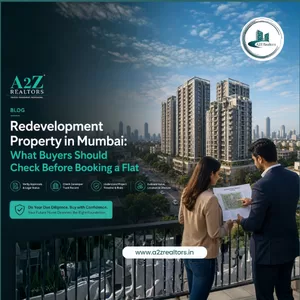

Redevelopment Property in Mumbai: What Buyers Should Check Before Booking a Flat.
Buying a new home in an established Mumbai location can feel exciting. However, it also requires careful research. Areas such as Khar, Bandra, Santacruz, Juhu and Andheri have limited open land. Therefore, many new homes now come through redevelopment projects in Mumbai.
In a redevelopment project, a developer replaces an old building with a new residential tower. Existing society members receive new homes, while the developer may sell additional apartments to new buyers.
For people planning to Buy Properties in Mumbai, redevelopment can offer access to well-developed neighbourhoods. These areas already have schools, hospitals, markets, transport links and social infrastructure.
Still, buyers should not book a flat only because the building looks modern. Instead, they must verify the project’s legal title, approvals, carpet area, possession date and total cost.
This guide explains what to check before buying a flat in a redevelopment project, especially in Khar and other prime Mumbai locations.
Before buying a redevelopment property in Mumbai, check the project on MahaRERA, confirm the developer’s legal rights, review the sanctioned plans, verify the carpet area and calculate the total cost. In addition, ask an independent property lawyer to examine the agreement before you make a large payment.
Table of Contents
- What is a redevelopment property?
- Why is redevelopment common in Mumbai?
- Is it safe to buy a redevelopment flat?
- What is a free-sale component?
- Redevelopment property buying checklist
- MahaRERA project verification
- Important documents to check
- Builder background verification
- Carpet area and layout checks
- Total cost and hidden charges
- Home-loan checks
- Possession and Occupation Certificate
- Common red flags
- Questions to ask before booking
- FAQs
- Conclusion
What Is a Redevelopment Property in Mumbai?
A redevelopment property is a new apartment built after a developer demolishes an old building or housing society.
In many society redevelopment projects in Mumbai, the developer builds replacement homes for existing members. The developer may also construct extra apartments and sell them to outside buyers.
These apartments are often part of the free-sale component.
Redevelopment may include:
- Cooperative housing society redevelopment
- Private building redevelopment
- MHADA redevelopment
- Cessed-building redevelopment
- Cluster redevelopment
- Rehabilitation-linked development
Each type follows a different legal and approval process. Therefore, buyers should not assume that all residential redevelopment projects Mumbai follow the same rules.
Why Are Redevelopment Projects Common in Khar and Mumbai?
Khar is a well-connected residential location. It offers access to schools, hospitals, shopping areas, restaurants and major business districts.
However, the area has very little vacant land. As a result, developers often create new redevelopment projects in Mumbai by replacing older buildings.
Redevelopment can bring several improvements, such as:
- New lifts
- Better fire-safety systems
- Improved parking
- Modern security
- Updated plumbing and electrical systems
- Better building design
- New amenities
For buyers, redevelopment apartments in Mumbai can offer a modern home in a mature neighbourhood.
However, buyers should still verify every important detail before booking.
Is It Safe to Buy a Flat in a Redevelopment Project?
Yes, a redevelopment flat can be safe to buy. However, buyers must complete proper checks first.
The project should have:
- Clear development rights
- Valid MahaRERA registration
- Approved building plans
- Construction permission
- A reliable developer
- A clear possession schedule
- Transparent pricing
- A fair agreement for sale
The main risks of buying flat in redevelopment project include:
- Disputes between society members and the developer
- Unclear land ownership
- Approval delays
- Construction delays
- Unapproved floors
- Weak developer finances
- Higher maintenance costs
- Incorrect carpet area
- Unclear parking rights
Therefore, buyers should complete proper property due diligence in Mumbai before paying a large booking amount.
What Is the Free-Sale Component in Redevelopment?
In a redevelopment project, the developer usually provides new apartments to existing society members.
In return, the developer may receive the right to construct and sell additional apartments. These saleable flats form the free-sale component.
Before you buy such a flat, check:
- Whether the developer has the legal right to sell it
- Whether the flat appears in the approved plan
- Whether the relevant floor has approval
- Whether MahaRERA lists the unit
- Whether the developer has already sold or mortgaged it
- Whether the agreement clearly mentions parking
- Whether you are paying into the correct project account
Do not rely only on brochures or verbal promises. Instead, ask for written proof.
Redevelopment Property Buying Checklist in Mumbai
The following redevelopment property buying checklist can help you review a project.
| Check | What to verify | Why it matters |
|---|---|---|
| MahaRERA registration | Project number, promoter and status | Confirms public registration |
| Developer’s rights | Development agreement and right to sell | Confirms legal authority |
| Property title | Ownership records and title report | Helps identify ownership problems |
| Approved plan | Flat, floor and building layout | Prevents purchase of an unapproved unit |
| Commencement Certificate | Permission for the relevant stage | Confirms construction approval |
| Carpet area | RERA carpet area in every document | Helps compare space and price |
| Possession date | Agreement and MahaRERA dates | Reduces confusion |
| Construction progress | Site work and official updates | Shows whether work matches claims |
| Legal disputes | Court and MahaRERA complaints | Identifies possible risks |
| Complete price | Taxes, charges and deposits | Prevents budget surprises |
| Home-loan status | Bank review of project and unit | Reduces financing uncertainty |
| Agreement terms | Delay, refund and cancellation clauses | Protects the buyer |
How to Check a Redevelopment Project on MahaRERA
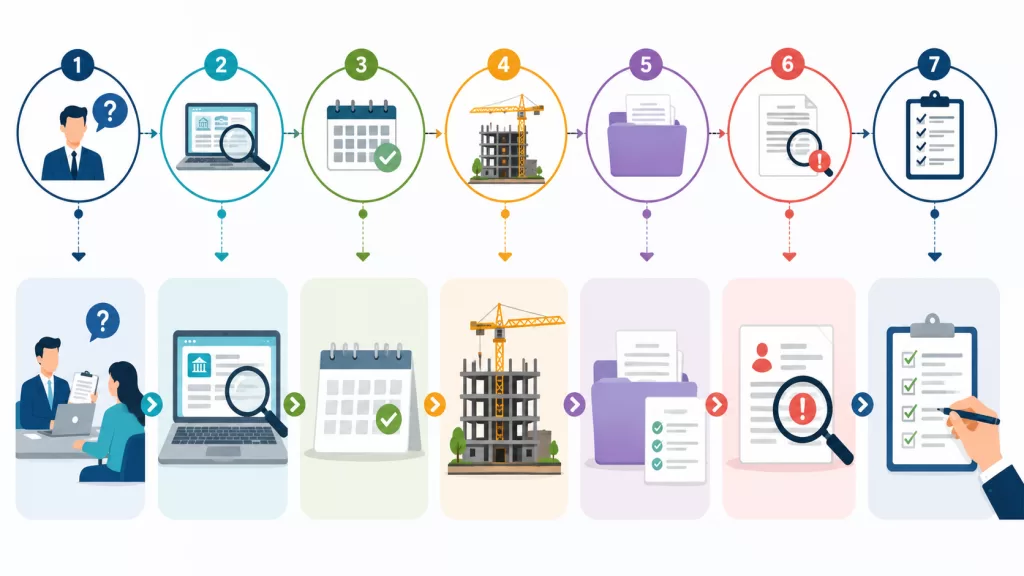
A buyer should always verify MahaRERA redevelopment projects on the official portal.
Step 1: Ask for the Registration Number
First, ask the developer for the MahaRERA number.
Be careful when a salesperson says:
- Registration is under process
- The number will come later
- The project does not need registration
- You can check after booking
Instead, ask for written clarification.
Step 2: Search the Official Portal
Next, search the project by:
- Registration number
- Project name
- Promoter name
- Location
Then, confirm the following:
- Project name
- Promoter name
- Project address
- Registration status
- Project phase
- Completion date
This step helps buyers understand how to verify a redevelopment project in Mumbai.
Step 3: Check the Possession Date
Compare the possession date shown on MahaRERA with:
- The brochure
- The cost sheet
- The allotment letter
- The agreement for sale
If the dates differ, ask the developer for an explanation.
Step 4: Review Construction Updates
Registered projects usually provide periodic updates.
Therefore, check:
- Current construction stage
- Uploaded progress details
- Revised completion dates
- Project extensions
- Approval updates
Missing or outdated information may need further investigation.
Step 5: Review Uploaded Documents
Check whether the portal provides:
- Registration certificate
- Title report
- Approved plans
- Commencement Certificate
- Draft agreement
- Inventory details
- Project extension documents
- Construction updates
This process forms part of a MahaRERA checklist for redevelopment property buyers.
Step 6: Search for Complaints
In addition, search for complaints against the project and developer.
A complaint does not always mean that the project is unsafe. However, you should understand the issue and final order.
Step 7: Compare the Agreement
Finally, compare the agreement given by the developer with the draft uploaded on MahaRERA.
Ask your lawyer to check:
- Carpet area
- Possession date
- Payment terms
- Delay clauses
- Refund terms
- Cancellation conditions
- Amenities
- Parking
- Extra charges
Documents to Check Before Buying a Flat in Mumbai
The exact documents depend on the project type. However, buyers should usually review the following records.
1. Title Documents
Title documents show who owns the land.
These may include:
- Conveyance deed
- Deemed conveyance order
- Property card
- Title certificate
- Title search report
- Land records
- Ownership chain documents
A lawyer should review these records. This is one of the most important legal checks before buying flat in Mumbai.
2. Development Agreement
The development agreement explains the relationship between the society and the developer.
It should confirm:
- The developer’s appointment
- The right to develop the property
- The right to sell extra flats
- The developer’s duties
- Construction timelines
- Approval responsibilities
- Termination conditions
Therefore, buyers should confirm that the developer can legally sell the selected unit.
3. Power of Attorney
The society or landowner may give the developer a power of attorney.
This document should allow the developer to:
- Apply for approvals
- Sign documents
- Carry out construction
- Sell authorised apartments
However, the developer should not act beyond the authority given in this document.
4. Society Records
Important society records may include:
- Society registration certificate
- General body resolutions
- Member consent documents
- Developer appointment resolution
- Conveyance records
These documents help buyers identify serious society disputes.
5. Intimation of Disapproval
The Intimation of Disapproval, or IOD, lists conditions that the project must follow.
However, an IOD does not always mean that the developer can construct every proposed floor.
Therefore, buyers should also check the Commencement Certificate.
6. Commencement Certificate
The Commencement Certificate allows the developer to begin construction for the approved stage.
Check whether it covers:
- The correct building
- The correct wing
- The relevant floor
- The selected flat
This is especially important in under-construction redevelopment projects Mumbai.
7. Sanctioned Building Plan
The sanctioned plan should show the approved building layout.
Compare it with:
- The sales floor plan
- The brochure
- The sample flat
- The agreement
Ask:
- Is this floor approved?
- Does the flat appear in the sanctioned plan?
- Are the balconies approved?
- Are all amenities approved?
- Can the developer change the layout?
8. MahaRERA Registration Certificate
Check that the certificate matches the:
- Project
- Phase
- Promoter
- Location
- Building wing
Do not accept the registration number of another phase or nearby building.
9. Mortgage and Encumbrance Details
A developer may use the land or project rights as security for finance.
Therefore, ask:
- Has the developer mortgaged the project?
- Will the bank give a unit-level NOC?
- Can the developer sell the flat without lender approval?
- Will the bank release the flat after payment?
A mortgage does not always create a problem. However, the release process must remain clear.
10. Agreement for Sale
The registered agreement should clearly mention:
- Flat number
- Floor
- Wing
- RERA carpet area
- Purchase price
- Payment schedule
- Possession date
- Taxes
- Parking
- Amenities
- Delay clauses
- Cancellation terms
- Refund conditions
- Maintenance charges
These are some of the most important documents to check before buying flat in Mumbai.
How to Verify the Builder’s Track Record
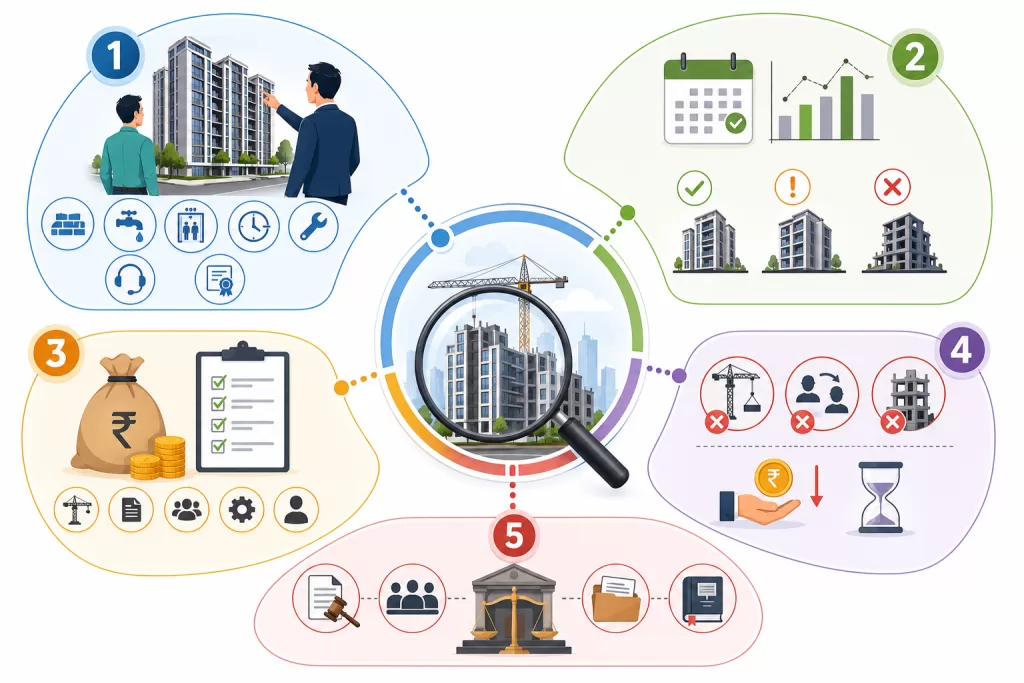
A known brand name does not remove all risk.
Therefore, buyers should complete developer due diligence for redevelopment property.
1. Visit Completed Projects
Visit at least one completed redevelopment project by the same builder.
Speak to residents about:
- Construction quality
- Leakage
- Lift performance
- Possession delays
- Maintenance
- Customer support
- Occupation Certificate
2. Compare Promised and Actual Possession
Next, check whether the builder delivered earlier projects on time.
A small delay may have a reasonable cause. However, repeated delays across several projects can be a warning sign.
3. Review Financial Strength
Redevelopment requires money for:
- Construction
- Approval fees
- Contractor payments
- Society rent
- Professional fees
- Project management
Be careful when you see:
- Long work stoppages
- Frequent contractor changes
- Several incomplete projects
- Delayed society payments
- Dependence on early buyer payments
5. Review Complaints and Court Cases
Ask a lawyer to check:
- MahaRERA complaints
- Consumer cases
- Court disputes
- Insolvency matters
- NCLT cases
- Title disputes
This process helps buyers understand how to verify builder track record before buying a flat.
How to Verify Carpet Area Before Booking a Flat
Mumbai property prices are high. Therefore, even a small difference in area can affect the total value.
The agreement should mention the RERA carpet area.
Do not rely only on terms such as:
- Saleable area
- Super built-up area
- Usable area
- Approximate area
Carpet Area Verification Steps
- Ask for the RERA carpet area.
- Compare it with the MahaRERA record.
- Check the agreement.
- Review the sanctioned plan.
- Compare room dimensions.
- Ask how the developer calculates passages and walls.
- Confirm what happens if the final area changes.
This process explains how to verify carpet area before booking flat.
Practical Example
Suppose two 2 BHK flats in Khar have different layouts.
- Flat A offers 720 sq. ft. of carpet area.
- Flat B offers 760 sq. ft. of carpet area.
At first, Flat B may look better. However, it may have a long passage and smaller rooms.
Therefore, buyers should also check:
- Room size
- Natural light
- Ventilation
- Storage
- Column positions
- Layout efficiency
A larger flat does not always offer better usable space.
Check the Floor, View and Surrounding Development
A project brochure may show an open view.
However, nearby plots may also enter redevelopment later.
Before paying a premium for a view, ask:
- Who owns the nearby plot?
- Can another tower come up?
- Is the view permanent?
- Can the developer add another wing?
- Are higher floors approved?
- Can the layout change?
This check matters in Khar because many surrounding buildings may also undergo redevelopment.
Understand the Complete Cost
The base price does not show the full cost of buying redevelopment flat in Mumbai.
Therefore, ask for an itemised cost sheet.
| Cost | What to check |
| Base price | Price based on carpet area |
| Stamp duty | Current applicable amount |
| Registration fee | Government registration cost |
| GST | Whether it applies to the flat |
| Floor-rise charge | Extra amount for higher floors |
| Parking | Type and written allocation |
| Maintenance deposit | Amount and period |
| Advance maintenance | Start date and monthly rate |
| Society charges | Purpose and calculation |
| Utility deposits | Electricity, gas and water |
| Legal charges | Exact service covered |
| Brokerage | Amount and payment stage |
| Loan charges | Processing and legal fees |
| Interior budget | Cost after possession |
Hidden Charges Buyers Should Question
Buyers should ask about vague charges such as:
- Administrative charges
- Development fees
- Facilitation charges
- Possession charges
- Infrastructure fees
- Other charges
These may become hidden charges in redevelopment property Mumbai if the developer does not explain them clearly.
GST on Redevelopment Flats in Mumbai
GST depends on the construction stage and the type of transaction.
Therefore, buyers should not assume that every redevelopment flat has the same GST treatment.
Ask for:
- Written GST calculation
- Construction status
- Tax breakup
- Payment schedule
- Tax invoice
In addition, consult a chartered accountant before making a final decision.
Stamp Duty on Redevelopment Property
Outside buyers usually need to pay stamp duty and registration charges on the sale agreement.
However, existing society members may follow different rules for replacement flats.
Therefore, buyers should not apply advice meant for society members to a free-sale purchase.
Always confirm the latest stamp duty on redevelopment property Mumbai with a qualified professional.
Home Loan for Redevelopment Property Mumbai
Many buyers assume that “bank approved” means guaranteed loan approval.
However, banks review both:
- The project
- The buyer
They may also check:
- Income
- Credit score
- Approved floor
- Project stage
- Mortgage release
- Property valuation
Before booking:
- Ask which banks have approved the project.
- Contact the bank directly.
- Share the exact flat details.
- Check your eligibility.
- Read the refund clause.
- Avoid relying only on the developer’s loan desk.
This is important when considering bank approved redevelopment projects in Mumbai.
Check the Possession Date Carefully
A project may show several possession dates.
These may include:
- Sales estimate
- Brochure date
- MahaRERA date
- Agreement date
- Handover date
- Occupation Certificate date
Therefore, ask which date is legally binding.
What Happens If a Redevelopment Project Is Delayed?
The answer depends on:
- Agreement terms
- MahaRERA status
- Delay period
- Buyer’s decision
- Legal remedies
Before booking, check:
- Delay compensation
- Interest
- Refund rights
- Grace period
- Extension clauses
- Cancellation terms
Do not wait for a delay before reading these clauses.
Occupation Certificate and Possession
Before taking possession, check whether the building has an Occupation Certificate, or OC.
The OC should cover:
- Your wing
- Your floor
- Your flat
Also check:
- Water supply
- Electricity
- Lift operation
- Fire-safety systems
- Parking
- Common areas
- Defects inside the flat
In addition, compare the completed flat with the agreement and sanctioned plan.
Maintenance Charges After Redevelopment
New buildings often have higher maintenance costs.
For example, the building may include:
- Multiple lifts
- Security guards
- CCTV
- Fire systems
- Mechanical parking
- Water pumps
- Common-area lighting
- Gym
- Clubhouse
- Backup power
Therefore, ask for an estimated monthly budget.
Also ask:
- Who will manage the building?
- When will the society take control?
- How much advance maintenance will buyers pay?
- Is parking maintenance separate?
- Will commercial units share costs?
This helps buyers estimate maintenance charges after redevelopment in Mumbai.
Red Flags in Mumbai Redevelopment Projects
Watch for these warning signs:
- The MahaRERA number does not match.
- The project name differs across documents.
- The selected floor lacks approval.
- The developer refuses to share plans.
- The possession date keeps changing.
- Important promises remain verbal.
- The salesperson pressures you to pay quickly.
- The carpet area remains unclear.
- The cost sheet includes unexplained charges.
- The developer discourages legal review.
- Society disputes remain unresolved.
- Construction has stopped.
- Mortgage details remain unclear.
- Parking does not appear in writing.
- Amenities appear only in the brochure.
One issue may have a valid explanation. However, several red flags in Mumbai redevelopment projects should make you pause.
Questions to Ask Before Buying Redevelopment Property
Ask the developer:
- Who owns the land?
- Does the society have conveyance?
- Can the developer sell this flat?
- What is the MahaRERA number?
- Is the project registration active?
- Is this floor approved?
- Does the Commencement Certificate cover this floor?
- What is the RERA carpet area?
- What is the official possession date?
- Has MahaRERA granted any extension?
- Has the developer mortgaged the project?
- Will I receive a lender NOC?
- What does the final price include?
- Is GST applicable?
- What are the maintenance charges?
- Does the agreement include parking?
- Are the amenities approved?
- Are there any disputes?
- What happens if my loan is rejected?
- What are the refund terms?
These are useful questions to ask before buying redevelopment property.
Common Mistakes Buyers Make
Choosing Only by Location
Khar is a premium location. However, a good location cannot fix legal or approval problems.
Treating MahaRERA as a Full Guarantee
MahaRERA registration improves transparency. Still, buyers need legal and financial checks.
Trusting Only the Builder’s Brand
A large developer may use a separate project company. Therefore, verify the exact promoter named in the documents.
Booking an Unapproved Floor
Always check whether the selected floor has construction approval.
Comparing Only Price Per Square Foot
Ask whether the developer uses carpet area or saleable area.
Ignoring Maintenance Costs
Modern amenities often increase monthly expenses.
Trusting Verbal Promises
Add every major promise to the agreement.
Using Only the Developer’s Lawyer
The developer’s lawyer protects the developer’s interests. Therefore, hire an independent lawyer.
Expert Tips for Buyers in Khar
Visit at Different Times
Visit the location during:
- Morning
- Evening
- Weekends
- Monsoon
- Peak traffic hours
This helps you understand noise, traffic, access and waterlogging.
Study the Entire Plot
Check:
- Rehabilitation wing
- Free-sale wing
- Entry and exit points
- Parking
- Commercial areas
- Amenities
- Construction phases
Compare Ready and Under-Construction Flats
A ready flat gives greater certainty.
However, an under-construction flat may offer:
- Flexible payments
- More unit choices
- Lower early-stage pricing
Choose based on your budget, timeline and risk comfort.
Keep Written Records
Save:
- Brochures
- Cost sheets
- Emails
- Plans
- Payment receipts
- MahaRERA details
- Legal reports
- Loan letters
Written proof is more useful than verbal promises.
How to Buy a Redevelopment Flat Safely
To buy redevelopment flat in Mumbai safely:
- Check the project on MahaRERA.
- Verify the land title.
- Confirm the developer’s sale rights.
- Review the sanctioned plan.
- Check the Commencement Certificate.
- Verify the carpet area.
- Review the builder’s track record.
- Search for disputes.
- Calculate the total price.
- Check home-loan approval.
- Ask a lawyer to review the agreement.
- Keep all promises in writing.
Frequently Asked Questions
1. Is it safe to buy a flat in a redevelopment project?
Yes, it can be safe. However, buyers should verify the title, MahaRERA registration, approvals, construction status, carpet area and agreement before booking.
2. What should buyers check before booking?
Buyers should check the developer’s rights, sanctioned plan, Commencement Certificate, MahaRERA details, possession date, cost sheet and legal documents.
3. How can I verify a redevelopment project in Mumbai?
Search the project on the MahaRERA portal. Then, compare the registered details with the brochure, agreement, plans and construction status.
4. What documents should I check?
Check the title report, development agreement, sanctioned plan, Commencement Certificate, MahaRERA certificate, mortgage details and agreement for sale.
5. Can I get a home loan for a redevelopment flat?
Yes, banks may provide loans for redevelopment flats. However, the bank will review both the project and the buyer.
6. Are maintenance costs higher after redevelopment?
They can be higher because new buildings often have more lifts, security systems, parking equipment and amenities.
7. Should I hire a lawyer before booking?
Yes. An independent property lawyer can identify title problems, approval issues and unfair agreement clauses.
8. What are common warning signs?
Unapproved floors, unclear carpet area, changing possession dates, pressure to pay quickly and missing documents are common warning signs.
Conclusion
A redevelopment property in Mumbai can offer a modern home in a prime area such as Khar.
However, buyers should not choose a flat only because of the location, builder name or launch price.
Instead, they should verify:
- Title and development rights
- MahaRERA registration
- Approved plans
- Construction permission
- Carpet area
- Possession date
- Total cost
- Agreement terms
Careful checks can reduce risk and help buyers make a better decision.
Planning to Buy Properties in Mumbai or explore redevelopment flats for sale in Mumbai?
A2Z Realtors can help you compare suitable options in Khar and other prime Mumbai locations based on your budget, preferred carpet area, construction stage and possession needs.
Contact A2Z Realtors to shortlist suitable properties and plan a site visit.
Disclaimer: This article provides general information only. It does not replace legal, tax, financial or investment advice. Buyers should verify current project details and consult qualified professionals before making a property decision.